

Digital detox? No need, Montessori in the early years is screen free
In a world where screens are part of everyday life, it can be surprising to enter an early-years Montessori classroom and see children learning without ipads , interactive whiteboards or personal devices. Instead, they are pouring water, sorting objects, tracing textured letters, building words, counting beads, preparing food and caring for their environment. This is not a gap in their education.
It is a purposeful approach that gives young children what they need most at this stage of development: real experiences, purposeful movement, human connection and uninterrupted time to think.

A screen-free environment is normal in Montessori
Montessori education begins with the understanding that young children learn through doing and by interacting with their surroundings. In the birth-to-six stage, they are building their understanding of the world through touch, movement, sound, sight, language and purposeful activity. For this reason, digital devices are not the default learning tool in an early Montessori environment. Children are offered carefully curated learning experiences that promote high levels of engagement resulting in long periods of concentration. It’s intentionally active learning, not passive.
Why does Montessori believe in active learning? Because the hands are a pathway to the mind.
Dr Maria Montessori described the hands as instruments of intelligence. When a child manipulates an object, the activity involves far more than the fingers. The child must observe, plan, coordinate movement, remember a sequence, notice differences, solve problems and adjust when something does not work.
Thought and movement operate together.
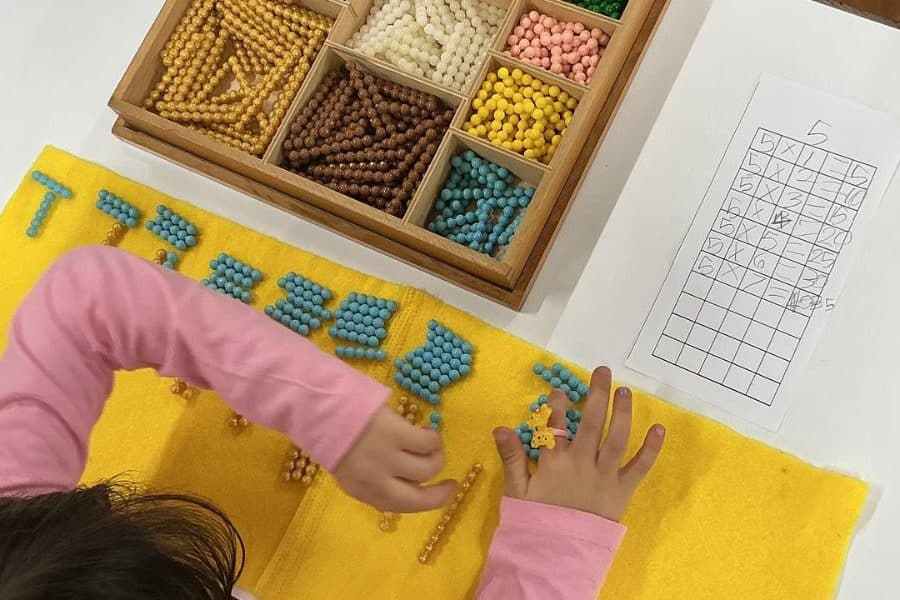
Montessori materials make ideas visible and tangible before children are asked to understand them in the abstract. A child can feel the shape of a letter before writing it, hold quantities before working with written numerals, and physically arrange parts before understanding a whole. These concrete experiences create meaningful mental connections. As understanding becomes secure, the child gradually moves from handling materials to working independently with ideas, symbols and imagination.
The children move around their environment independently and with agency.

How does hands-on learning build concentration and independence?
Unlike a screen that supplies rapid images and responses, Montessori hands-on learning materials invite the child to set the pace. They select the activity, carry it carefully, complete each step involved in the work, and observe their results. When complete, the child returns the activity to its allocated place, ready for the next child to use.
Most Montessori learning materials are self-correcting. Children can recognise and correct a mistake without waiting for an adult to supply the answer. This develops persistence, self-monitoring and confidence.
The variety of materials in the preschool (ages 3-6) classroom are designed for early learners to develop:
- Concentration, patience and sustained attention
- Fine-motor coordination and preparation for writing
- Working memory, sequencing and problem-solving
- Spatial awareness and mathematical thinking
- Independence, confidence and responsibility
- Language, social interaction and real-world understanding
What do children gain when screens do not lead the learning?
On entering a Montessori classroom for the first time, visitors often comment on how calm and quiet the environment is. This is because children are not passively consuming information or being controlled by the educator. Instead, it is calm because they are actively engaged. Children move with purpose. They communicate with educators and peers, observe others, make choices and return to work that interests them. The uninterrupted work cycles in the morning and afternoon provide time to concentrate deeply rather than continually shifting their attention.
In place of digital activities, the Montessori prepared environment offers rich opportunities across practical life, sensorial exploration, language, mathematics, culture, art, music and care of the natural world. Children wash, polish, sweep, garden, classify, construct, draw, sing, listen and collaborate. These are not simply ways to keep small hands busy. They are intellectually valuable experiences that integrate body and mind while giving learning a real purpose.
Why we emphasise purposeful use, not rejection of technology
A screen-free early childhood environment does not mean technology is viewed as inherently bad. It means educators make careful decisions about when it genuinely adds value. At Forestville Montessori School, digital devices are limited in the Toddler and Preschool programs. Any screen or device use is supervised, age-appropriate and purposeful. Technology may support a specific activity, such as music or an instructional resource, or a child listening to a story in the reading corner but it does not replace direct experience, relationships or the child’s own active participation.
How does Montessori prepare children for a digital world?
We don’t. We prepare their minds for judicious decision making. Preparing children for the future is not simply a matter of introducing devices earlier. Before children use digital tools independently, they benefit from strong foundations in concentration, communication, motor control, critical thinking, creativity, self-regulation and social awareness. Montessori develops these capacities through meaningful work in the real world.

When young children are given time away from screens, they are not missing out.
They are looking closely, listening carefully, moving purposefully and learning with their whole selves.
In a Montessori classroom, this is not a special program or a temporary digital detox. It is simply how early learning happens: through the hands, the senses, relationships and joyful engagement with the world.


